How to Reward Customers for Reviews and UGC
A genuine reward changes review and UGC response rates from 1-3% to 15-30%. Here is what you are allowed to offer, how much to pay, and why delivery format matters more than most brands realise.
Customers do not spontaneously write reviews or submit photos for your brand. That is not cynicism - it is a reasonable allocation of their time. Writing a considered review or photographing a product in good light takes ten to fifteen minutes. Most people will not spend ten minutes on a task with no return.
The fix is obvious in theory and consistently underdone in practice: reward the effort. A genuine incentive changes the response rate from the 1-3% typical of unincentivised requests to 15-30% for brands that offer something real. And the economics justify the investment: a July 2026 Social Tip study across 17 brands found 3-5x Day 1 ROAS from customer content programmes - before the content had even been seen by anyone outside the creator's immediate network.
The complication is doing this in a way that is legally sound and practically useful. Rewarding a submission is permitted. Purchasing a verdict is not. Delivering the reward via email puts it in a folder most customers never check. Delivering it via wallet pass puts it on the lock screen.
"Ask for a photo, not just stars. Counterintuitive but photo requests often convert better and the reviews are way more valuable for future buyers." — r/smallbusiness
What You Are Allowed to Reward
The legal framework for incentivising customer content is clear on one distinction: you can reward the act of submitting, but not the sentiment of the submission.
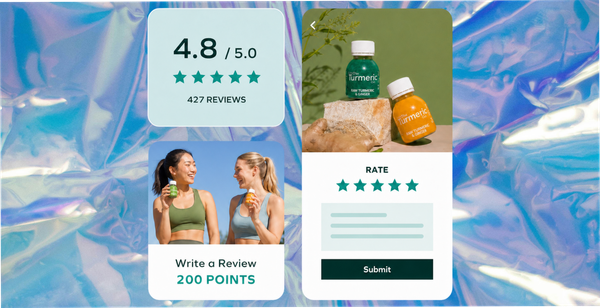
"Submit a review and receive $10 off your next order" is permissible. You are paying for the customer's time and effort in completing the submission. The customer could write a two-star review and still receive the reward. The incentive does not influence the rating or content - it influences whether the customer submits at all.
"Submit a five-star review and receive $10 off" is not permissible. You are purchasing a specific verdict, not rewarding a submission. This violates FTC endorsement guidelines, Trustpilot terms, Google review policies, and most major review platform policies. It also undermines the review's value as social proof - a review that was purchased as a specific rating carries no authentic signal.
This distinction matters practically as well as legally. Brands that reward submissions - not ratings - build a review library that includes negative reviews. A product page with 47 reviews averaging 4.2 stars converts better than one with 12 reviews averaging 5.0 stars, because the 4.2 with volume looks real. The 5.0 with low volume looks curated.
Incentivising reviews is not the same as buying them covers the legal and practical distinction in more detail.
What to Offer: Reward Formats
The reward format matters as much as the reward value. A $10 incentive delivered as a wallet pass converts to a repeat purchase at a different rate than the same $10 delivered as a coupon code in an email.
Discount codes by email are the most common approach and the least effective delivery mechanism. The code arrives in an email that competes with every other promotional message in the customer's inbox. Most customers do not retrieve the code at the point of their next purchase. The conversion from code issued to code used is consistently lower than for other delivery formats.
Gift cards have similar problems. A gift card value issued to an email address requires the customer to find the email, retrieve the card details, and enter them at checkout. Unless the customer specifically saves the card, it is effectively lost after the first week.
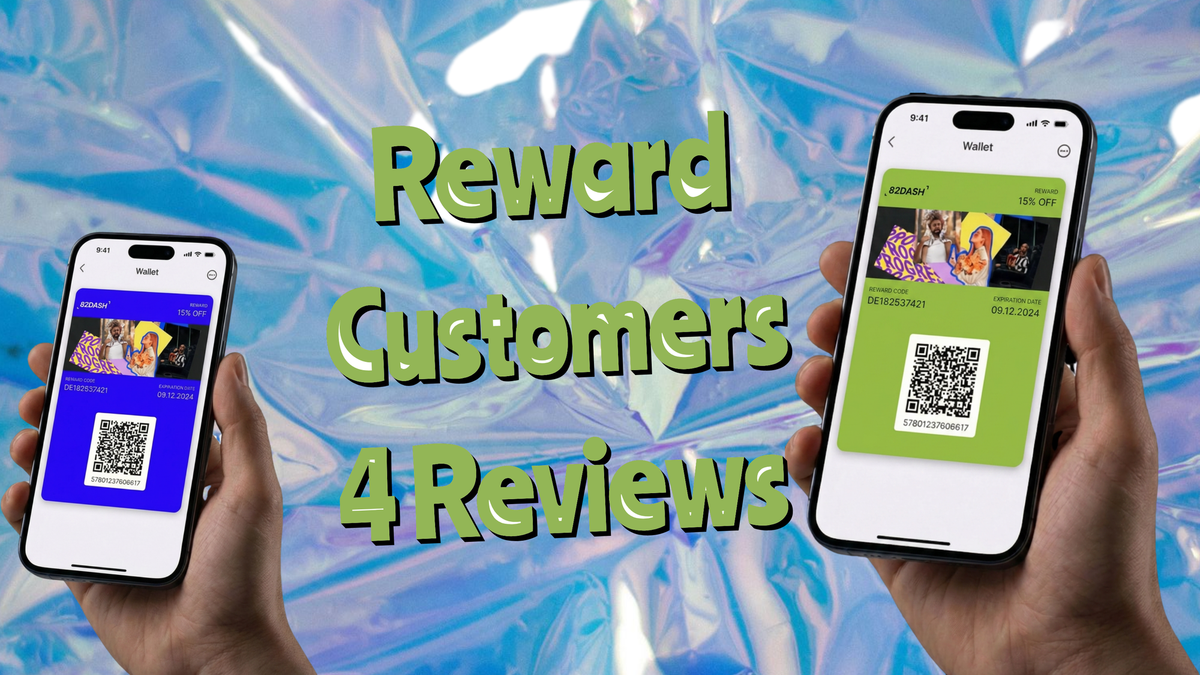
Wallet passes delivered to Apple or Google Wallet are the most effective reward format for a post-purchase context. The reward installs on the customer's phone with one tap, is visible from the home screen, and resurfaces as a lock screen notification as the expiry approaches. At the point of the customer's next purchase, the reward is already in the wallet app alongside their payment cards - accessible without searching for an email or remembering a code.
How to reward customers for photos, videos and feedback covers the conversion rate differences between reward delivery formats and the mechanics of wallet pass delivery.
Reward Values That Work
There is no universal right answer on reward value, but there are useful benchmarks.
For written reviews: $5-$10 off the next order is sufficient for most customers who were going to buy again anyway. The reward tips the decision to write the review rather than skip it. Too low (under $3) does not change behaviour. Too high (over $20 for a brief review) raises eyebrows.
For photos: $10-$15 is the standard range. A photo requires more effort than a written review (taking the shot, selecting the best image, uploading), so the reward should reflect that. $10 off is effective for fast-moving consumer goods; $15 is appropriate for higher-price-point products.
For videos: $15-$25 reflects the higher time investment of filming, reviewing, and uploading a short video. A 30-second product video takes more than twice as long as a written review to produce. Brands collecting video for use in Meta ads often offer the highest reward in their programme for video content.
For all three: offering a combined reward for a customer who submits a review, a photo, and a video - perhaps $25-$30 for completing all three at different timing points in the post-purchase sequence - is the highest-value submission a customer can make. Structuring this as a progressive programme (earn $5 for the review, $10 more for the photo, $15 more for the video) is more effective than offering a lump sum upfront.
When to Make the Ask
The reward makes a customer more likely to submit. The timing determines whether they have anything worth submitting.
A review request with a reward offer that arrives on day one of delivery is still asking for a review of a product the customer has not used. The incentive cannot compensate for the timing problem.
Reviews: day 10-14 after confirmed delivery for most physical products. The customer has used the product, formed an opinion, and can write something specific. For skincare, supplements, or products where results take time, extend to 3-4 weeks.
Photos: day 14-21. Photos require the customer to find a moment worth capturing, set up the shot, and upload. Slightly more runway than a review request is useful.
Videos: day 14-21. Same as photos. A customer who has not integrated the product into their routine will not have an authentic use-case moment to film.
Follow-up: a second ask, sent only to customers who did not respond to the first, two to three weeks after the original. Response rates on the follow-up are lower but not negligible - some customers missed the first email, some deferred and forgot, and a reminder at the right moment converts them. Do not follow up more than once; it crosses into pestering.

Rewarding Reviews vs Rewarding UGC
The mechanics of rewarding a review submission are slightly different from rewarding a photo or video, because the destination is different.
A review goes to a third-party platform (Shopify product reviews, Yotpo, Okendo, Trustpilot, Google Reviews). The submission happens on that platform, and the brand typically triggers the reward automatically when the review is verified as received. The challenge is the verification step - most review platforms have an API or webhook that can fire when a review is submitted, which the reward system can listen for.
A photo or video goes to a brand-controlled submission form. The brand receives the content, clears the rights, and releases the reward from the same system. The loop is tighter and the verification is immediate - the form submission is the trigger.
For brands running both: the cleanest approach is a post-purchase sequence with two separate asks at different timing points, each with its own reward, rather than one combined ask that tries to cover both. A customer asked to submit a review AND a photo simultaneously has two decisions to make. Two separate asks are each one decision - and one-decision requests convert better.
CGC vs UGC: rights, quality, and ROI explained covers the rights implications of different content collection methods, and why the submission form model produces legally cleaner content than retroactive social permission.
Making the Reward Visible
The most common reason a reward fails to drive a repeat purchase is not that the customer ignored it - it is that they forgot it existed.
An email coupon code is easy to forget. It sits in a folder alongside other promotional emails. The customer does not encounter it at the point of purchase; they encounter it at the point of searching their email while already in checkout.
A wallet pass reward on the customer's phone is a different proposition. The card is in the Wallet app alongside payment cards. When the customer opens Apple Pay or Google Pay, the reward card is visible. The expiry date, visible on the card, creates time-sensitive urgency without requiring the brand to send an additional reminder.
Push notifications make the visibility active rather than passive. A notification three to five days before the reward expires ("Your $10 reward expires on Friday") reaches the customer on their lock screen. Brandmovers research puts wallet pass push notification open rates at approximately 99%, compared to around 20% for the equivalent email.
The reward that is easy to see is the reward that gets used. The reward that gets used is the repeat purchase the brand wanted.
Running Rewards at Scale
Individual reward management - generating a code, emailing it, tracking whether it was used - does not scale beyond a few hundred customers. An automated reward flow handles this across any order volume.
The flow: customer submits review or content through the appropriate form or platform, trigger fires, wallet pass generated and sent to customer email address, customer installs with one tap, balance visible immediately. No manual steps. No code management. No email thread.
Automation also handles the edge cases: rewards that expire and need a reminder notification, customers who submit multiple times (the flow can recognise a known customer and add to an existing pass rather than issue a new one), and reward values that differ by content type (video rewards higher than photo, photo higher than review).
82DASH connects the post-purchase content collection brief, submission form with rights clearance, and wallet pass reward delivery for Shopify brands - handling the full reward flow from brief to redemption in a single automated system.
Isabelle Simon - Communications Lead - 82DASH
Frequently Asked Questions
Is it legal to offer rewards in exchange for reviews?
Yes, with one constraint: the reward must be for the submission, not for a specific rating. "Write a review and get $10 off" is permissible - you are rewarding the effort regardless of what the customer says. "Write a five-star review and get $10 off" is not permissible - you are purchasing a verdict. The distinction is important for FTC compliance and the terms of most review platforms. Reviews submitted in exchange for a reward should also be disclosed as incentivised.
What is the best reward to offer customers for UGC?
Wallet passes delivered to Apple or Google Wallet consistently outperform coupon codes sent by email. The wallet pass is visible from the lock screen, accessible at the point of purchase without searching an inbox, and can receive push notifications as the expiry approaches. For value, $10-$15 for a photo and $15-$25 for a video are effective ranges for most DTC brands. The right value depends on your product price point - the reward should feel proportionate to the product, not trivially small.
Can the same customer be rewarded for both a review and a photo?
Yes, and structuring separate rewards for each is more effective than offering one combined reward. Two separate asks at different timing points (review at day 10-12, photo at day 14-16) each produce higher conversion than a single combined ask. The rewards can accumulate on the same wallet pass - the review reward adds to the balance, and the photo reward adds again - so the customer sees a growing incentive rather than two separate codes.
How do I track whether a rewarded review was submitted?
Most review platforms (Yotpo, Okendo, Trustpilot) have an API or webhook that fires when a review is verified as submitted. The reward system listens for this trigger and issues the reward automatically. For Shopify's native review system, the equivalent trigger is available via the Shopify API. For content submissions via a form, the form submission itself is the trigger.
What happens if a customer submits a negative review? Do they still get the reward?
Yes, if you are rewarding the submission rather than the sentiment. A customer who submits a two-star review in a properly structured incentive programme still receives the reward - because you offered payment for the time and effort of submitting, not for a positive outcome. Withholding a reward for negative content would transform the incentive into a sentiment purchase, which is what the FTC rules and platform policies prohibit.