Photo Challenge Ideas for Brands: 40 Prompts by Business Type
Most photo challenge prompts are written for the brand, not the customer. Forty that work, grouped by business type, with four venue campaigns set out in full.

The difference between a photo challenge that fills your content library and one that produces almost nothing is usually the prompt.
"Share your experience" gets nothing. "Show us where it ended up" gets a photograph of a sofa in a real living room, which is the thing you actually wanted.
This is forty prompts grouped by business type, four worked examples for venues, and the three rules underneath all of them.
The Three Rules
Name the subject, not the feeling. The customer cannot photograph a feeling. "Show us the moment it arrived" is a picture. "Tell us how it made you feel" is an essay nobody writes.
Ask for one photograph. Multi-part prompts give people more to arrange before they can start, which is where submissions are lost. If you want three angles, that is three prompts across a challenge, not one prompt with three parts.
Make it possible from where they are. A prompt that requires good light, a tidy room and twenty minutes will be completed by the few customers who were going to post anyway. A prompt that can be done at a kitchen table at nine in the evening gets you everybody else.
40 Prompts by Business Type
Food and drink (1 to 6)
- The first thing you made with it
- It, on the table you actually eat at
- The moment before the first bite
- What you drank it with
- Your cupboard, with it in place
- The one you saved for last
Fashion and accessories (7 to 12)
- Worn somewhere ordinary
- The outfit you built around it
- It, on the third day of wearing it
- In the bag, going somewhere
- Your version, which is not how the model wore it
- It after a year, honestly
Beauty and skincare (13 to 18)
- Where it lives on your shelf
- Mid-routine, not after
- Your hand, holding it, in your own bathroom light
- The one you replaced
- Packed for a trip
- Week one beside week eight
Home and furniture (19 to 24)
- Where it ended up
- The corner it changed
- It, with the thing it replaced still visible
- In the light you get in the morning
- The detail you noticed after a month
- The room, from the doorway
Venues, hospitality and experiences (25 to 30)
- Your table, as you found it
- The view you did not expect
- What you ordered, before anybody touched it
- The bit of the room nobody photographs
- Your booking on your phone, on the way
- The reason you will come back
Venues: cafes, salons, studios and clubs (31 to 40)
- Your usual order, in your usual seat
- The finished look, in natural light by the window
- Your post-class ritual, whatever it is
- Your doubles team, straight after the match
- The table, before anybody touched anything
- What you always order that is not on the specials board
- Your gear, laid out before you started
- The corner of this place nobody photographs
- Proof you came back
- The staff member who remembers your name, with their permission
Four Worked Examples for Venues
A prompt on its own is half a campaign. This is what the other half looks like.
| Business | The prompt | Where you ask | The reward | Window | What you use it for |
|---|---|---|---|---|---|
| Cafe | Your usual order in your favourite seat | Table card and receipt footer | Free coffee on the next visit | Ongoing | Instagram grid, Google Business photos, local ads |
| Padel club | Your doubles team after the match | Courtside sign and booking confirmation | Court credit or a ball tube | Ongoing | Membership landing page, paid social |
| Salon | Your finished look in natural light | Follow-up message the day after the appointment | Credit against the next booking | 7 days | Service pages, before-and-after galleries, ads |
| Wellness studio | Your post-class ritual | Reception card and the class follow-up | A free class or a smoothie | 14 days | Class timetable pages, email, community posts |
One of them in full
The salon. The ask goes out the morning after the appointment, not at the chair, because the client has not seen the cut in their own mirror yet and the salon lighting flatters in a way daylight does not.
The message names one photograph, one place to send it, and what they get: credit against the next booking. The window is seven days, which is long enough for a weekend and short enough to still feel connected to the appointment.
What comes back is a photograph of a real client, in real light, with a real haircut they were happy enough with to photograph. That is the image you cannot buy and cannot fake, and with permission captured at submission it can go on the service page and into paid social rather than only onto a story that disappears.
The second ask is easier than the first, because you are writing to somebody who has already taken part.
Why Vague Prompts Get Nothing
A customer receiving "share a photo of your purchase" has to make four decisions before they can act: what to photograph, where, in what light, and whether their version is what you wanted. Most people resolve that by doing nothing.
A specific prompt makes those decisions for them. "It, on the table you actually eat at" removes the styling question entirely and produces something more useful than a styled shot would have been, because the whole value of customer content is that it does not look like a studio.
Three more decisions worth making before you send anything.
When it fires. A photo request at checkout gets nothing, because the customer has not received the product. Days after delivery is the moment, and for a venue it is during or just after the visit.
What they get. Photographing something, framing it and uploading it is real work, and the response rate tracks whether the exchange feels fair. Immediate delivery is worth testing against a larger reward sent later, because the two fail in different ways: one can feel too small, the other gets lost in an inbox.
Whether you can use it. This is the one that gets skipped. A customer sending you a photograph has not, by that act alone, given you permission to run it as an advertisement. Before it goes on a product page, in an email or behind paid media, you need their permission covering that use. Capturing it at submission is the cleanest way, because the agreement stays attached to the file.
Contests, Briefly
A contest is one version of a photo challenge: everybody enters, one person wins.
It works when you want a burst of entries around a moment. It works less well as a standing programme, because a single prize gives everybody who is not going to win a reason not to start.
For most brands a reward for everybody who takes part produces more content than a prize for one person. Our tips page on running a content competition covers the mechanics if a contest is the format you want.
One legal note either way. Rewarding somebody for content creates what the FTC calls a material connection between you and them, and where that connection is not obvious to the audience it has to be disclosed clearly and conspicuously. What that means in practice depends on the endorsement and where it runs, and the FTC's endorsement guides set out the detail. Two principles hold across cases: reward the act of submitting rather than a positive opinion, and keep any disclosure with the content rather than buried in terms. This is general information rather than legal advice, and anything running at scale is worth putting past a lawyer.
Where to Put the Request
The prompt decides what you get back. The placement decides how many people see it at all.
| Placement | Reaches them | Best for |
|---|---|---|
| Follow-up email, days after delivery | Unhurried, at home | Photos of the product in use |
| Packaging insert | At unboxing, and again weeks later on a counter | The highest-effort prompts |
| Post-purchase page | At peak goodwill, before delivery | Signing people up to a challenge that fires later |
| SMS | Immediate, high open rate | Time-bound challenges |
| Receipt or counter code | In person | Venues and physical retail |
The packaging insert is the one most brands overlook. An email gets one shot at an inbox. A card in the box sits on a kitchen counter for weeks, which means it is still there at the point the customer finally has something to photograph.
Two technical checks before you send anything. Test the submission page on an iPhone and on an Android handset, because camera permissions and uploads behave differently and a page that works on one can fail on the other. And if the reward is a wallet pass, make sure it saves on both, since one that works only in Apple Wallet excludes a large share of your customers. StatCounter is the quickest way to check your own split.
How 82DASH Fits
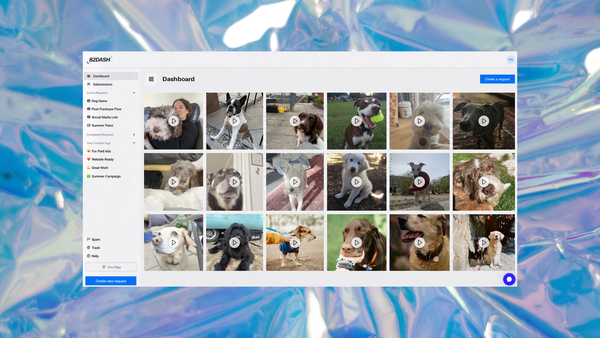
82DASH is a customer content library. It collects photos, videos and feedback directly from customers, and a reward lands in their Apple Wallet or Google Wallet when they submit.
The prompts above are the input. What the platform does is everything after: the submission arrives attributed, with permission attached, in a place you can search in six months.
Challenge Mode runs a series of prompts to the same customer across a window, with due dates and a cap, which is how you get six photographs from one person instead of one.
Two things matter more than the collection itself.
Rights are cleared at submission, which is the difference between a photograph you have and one you may run behind paid media. The rights management page sets out how, and the tips page on choosing the right content request type covers matching the ask to the product.
The reward persists on the phone after it is spent, so the second request goes to somebody who has already said yes once rather than to a stranger.
On plans. The free plan covers branded forms and wallet passes up to 50 submissions a month, so the reward half of this is testable at no cost. Photo collection is on the paid plans. Starter and Growth include a seven-day free trial, which is how to run a real challenge and count what comes back. Monthly plans start at $50, with around 15% off annually, and the pricing page has the current detail.
Underneath it: pay your customers, not creators. The budget going to commissioned content could go to the people who already bought from you, and their version carries more weight because nobody paid them to hold the opinion.
Start free with forms to Apple and Google Wallet
Isabelle Simon, Communications Lead, 82DASH
FAQs
What makes a good photo challenge prompt?
A named subject rather than a feeling, one photograph rather than several, and something possible from where the customer already is. "Show us where it ended up" works. "Share your experience" does not, because the customer has to make four decisions before they can act.
How many prompts should a brand challenge have?
Five to eight across a window of a week or two. Enough that somebody can take part more than once, few enough that it does not feel like homework. Expect partial completion and set the next list from what actually came back.
When should a photo request be sent?
Days after delivery, not at checkout. A customer who has not opened the box has nothing to photograph, and sending at checkout is the commonest way to get a zero response rate. For a venue, during or just after the visit.
Is a contest better than rewarding everybody?
A contest suits a burst of entries around a moment. For a standing programme, rewarding everybody who takes part produces more content, because a single prize gives everybody unlikely to win a reason not to start.
Do I have to disclose that customers were rewarded?
Where the reward is not obvious to the audience, yes. A reward creates a material connection under the FTC's endorsement guides, and it has to be disclosed clearly and conspicuously. What counts as clear depends on the format and the placement. Reward the act of submitting rather than a positive review, and keep the disclosure with the content rather than in terms nobody opens.
Can I run customer photos in paid ads?
Only with permission from the customer that names commercial use. Receiving a photograph is not by itself a licence to advertise with it, and a public post is not consent either. Capturing permission at submission is the cleanest route, though you can ask later.
Further Reading
- Photo scavenger hunt: 50 ideas, rules and a collection checklist
- Photo challenge or scavenger hunt: which should you run?
- Shopify customer photo contest: reward by selection
- Rights-cleared UGC for Shopify ads: the complete guide
- Apple Wallet developer documentation
- Google Wallet developer documentation
- FTC endorsement guides: what people are asking
- Shopify