AI Ad Labels in 2026: Meta, Google and TikTok Do Not Agree, and You Run Ads on All Three
Meta, Google and TikTok each run a different AI disclosure regime in 2026. A creative that is compliant on one is not automatically compliant on the next.
This article is general information about platform advertising policies and content disclosure rules. It is not legal advice. Platform policies change frequently and legal obligations differ by jurisdiction. Check the current policy documentation and your own position with a qualified adviser before acting on anything here.
There is no single rule for disclosing AI-generated advertising creative. There are three rulebooks, written by three companies with different commercial incentives, enforced by three different systems, and a creative that is compliant on one is not automatically compliant on the next.
This is a more immediate problem than the legislation everyone is discussing. A law arrives on a stated date after a consultation period. A platform policy arrives when the reviewer applies it to your ad, and the consequence is not a fine at some future point, it is your campaign not running on the Friday of a launch week.
What follows is what each platform actually does, drawn from the platforms' own material rather than the considerable volume of secondary commentary that has overstated all three.
From r/europe:
"That's good, but much more needs to be done. All content needs to be marked where AI was used. It would be great if they also detailed the areas in which AI was used. Maybe they simply wrote the code, maybe they translated the text into other languages, maybe AI composed the music. Maybe everything was done with AI. This needs to be noted, and then buyers will decide whether they want to pay for it or not."
He is describing a label that does not exist anywhere, and the distance between what he wants and what the platforms have actually built is the subject of this article.
What has shipped is a single binary flag. AI was involved, or it was not. Not which part, not how much, not to what end. And the three platforms do not agree on when that flag should trip, which is why identical creative can carry a label on one and nothing on another.
His choice of example is unlucky in a way worth noticing. Translation is the one use of AI that disclosure regimes have tended to carve out on purpose: New York's synthetic performer law, for instance, expressly exempts advertising where AI is used solely to translate a real human performer. The use he most wants surfaced is the one the drafters decided did not need surfacing.
So the position is worse than a simple gap. He gets a label that tells him almost nothing about what he is buying, and the advertiser gets three separate rulebooks to satisfy. The granularity he is asking for would arguably serve both sides better than what either currently has.
Google: A Panel, a Control, and a Great Deal of Overstatement
Google announced its expanded AI transparency features on 9 July 2026. The announcement is short and worth reading in the original, because the summaries of it have not been reliable.
What Google said it is doing:
- Adding a "How this ad was made" section to the My Ad Center panel, reachable through the three-dot menu on ads across Search, YouTube and Discover, available globally
- Automatically adding a disclosure to that panel when advertisers use Google's own generative AI advertising tools
- Introducing a control so advertisers who created creative elsewhere can indicate that generative AI was used
- Noting that "based on local requirements, a label may also appear directly on the ad", either automatically or when the advertiser uses the control
That final clause is doing the heavy lifting, and it is where the secondary coverage has gone astray. Several widely shared posts describe a blanket global mandate to label every AI-touched ad, with account suspension for failure. Google's own announcement does not say that. It describes a disclosure surface that lives in a panel by default, with a label appearing on the ad face itself where local law requires it.
What has not changed, and matters more: Google's existing misrepresentation policy already prohibits manipulating media to deceive or mislead, and has done for years. Deepfake-style creative depicting real people was prohibited before any of this. Google also embeds SynthID, its own imperceptible provenance signal, in outputs from its generative tools, and it has required disclosure of synthetic or digitally altered content in election ads since 2023.
The practical reading: for ordinary commercial creative outside jurisdictions that mandate on-ad labels, Google is currently building tooling and transparency rather than a punitive enforcement regime. The deception rules are the ones with teeth, and they apply whether or not AI was involved.
Meta: Automatic Labelling and the Variant Problem
Meta's approach is the opposite of Google's in one important respect. Meta does not wait for you to declare anything.
Meta applies an "AI info" label in two circumstances. First, when the advertiser used Meta's own generative creative features inside Ads Manager, including Background Generation, Image Generation and Add Animation. Second, when Meta's own detection identifies third-party generative tools in the creative. The label sits on the "About this ad" screen, and for photorealistic AI-generated people it can appear next to the Sponsored tag in the feed itself.
Meta also provides a disclosure control in Ads Manager for creative containing AI-generated or AI-manipulated content, so there is a declaration path, but the detection runs regardless of whether you use it.
Then there is the part that catches people out.
Meta's April 2026 update established that the running advertiser is responsible for AI-generated creative variants regardless of who configured the campaign. If an automated campaign type generates variants of your creative, those variants are yours. This is the most under-discussed exposure in the current landscape, because it means a brand can be running AI-generated creative it did not knowingly make, did not review, and cannot easily inventory.
If you use automated creative features and you have never audited what they produced, you do not currently know what is running under your account name.
On enforcement, Meta operates a strike system rather than a single penalty: a first violation stops the ad and adds a policy strike, a second within 90 days can trigger a short account hold, and repeated violations escalate towards suspension. Separately, where Meta assesses AI-generated content as deceptive, it can both apply a more prominent label and substantially reduce distribution, which is the quieter and more expensive outcome. An ad that is technically running while reaching a fraction of its intended audience is harder to diagnose than an ad that was rejected outright.
TikTok: The Broadest Definition of the Three
TikTok's synthetic and manipulated media rules under its Community Guidelines apply across organic posts, branded content and paid advertising, which makes them the widest in scope.
TikTok requires disclosure of AI-generated visuals and audio that depict realistic people or scenes. In practice that captures synthetic faces and face swaps, cloned or AI-generated voices, AI-generated backgrounds and environments, and photorealistic synthetic product shots that could be mistaken for real photographs.
Creators and advertisers can disclose through the AI-generated content toggle, on-screen text, a caption, a sticker, a watermark, or context in the description. Using more than one method is sensible, since the standard is whether a viewer would notice.
For paid media specifically, TikTok's advertising policy draws its line at content "significantly modified by AI", meaning changed beyond minor tweaks or enhancements, and states that undisclosed AI-generated content will be rejected or restricted.
TikTok also reads C2PA Content Credentials to detect synthetic media automatically, which is the same provenance standard the major model providers are now embedding under California's AI Transparency Act. That interlock is worth sitting with for a moment: the law obliges the generation tools to stamp their output, and the platform reads the stamp. Self-disclosure is one route to a label. It is not the only route.
The Comparison, Side by Side
| Meta | TikTok | ||
|---|---|---|---|
| Applies to | Facebook and Instagram ads | Search, YouTube, Discover | Organic, branded content and paid |
| Self-declaration | Control available in Ads Manager | Control for creative made outside Google tools | Toggle, plus text, caption, sticker or watermark |
| Automatic labelling | Yes, for Meta's own AI tools and detected third-party tools | Yes, for Google's own generative ad tools | Yes, via C2PA detection |
| Where the label appears | "About this ad", sometimes beside Sponsored | "How this ad was made" panel in My Ad Center; on-ad where local law requires | On the video, via the disclosure method used |
| Detection independent of you | Yes | SynthID on Google's own outputs | Yes, C2PA Content Credentials |
| Trigger threshold | AI-generated or AI-manipulated creative | Created or edited with generative AI | "Significantly modified by AI", beyond minor tweaks |
| Consequence of non-disclosure | Ad stopped, policy strike, escalation to account hold; reduced distribution where deemed deceptive | Existing misrepresentation policy applies; deceptive creative disapproved | Ad rejected or restricted; four-tier penalty escalation |
| Liability for auto-generated variants | Running advertiser is responsible regardless of who configured it | Not specified in the July announcement | Not specified |
| Notable carve-out | Minor retouching not treated as generation | Ordinary commercial creative labelled in panel rather than on ad face | Audio-only and minor enhancement below threshold |
Scroll the table sideways on a narrow screen.
The row that should worry a performance marketer most is the second from the bottom, and the row that should reassure everybody is the last one. Retouching a real photograph is not treated as generation on any of the three platforms. Colour correction, background cleanup and object removal sit below every threshold here.
The exposure attaches to imagery that invents a person or a scene. Every one of these regimes is built around the same question: is there a human being in this advertisement who does not exist?
The Answer That Sidesteps the Question
There is a category of advertising creative that none of this touches, and most brands are sitting on the raw material for it without having organised the collection.
A photograph or a short video taken by an actual customer, of an actual product, is not AI-generated content. It carries no provenance metadata, triggers no automatic detection, needs no disclosure toggle, and cannot be labelled as synthetic because it is not synthetic. The compliance question does not get answered; it does not arise.
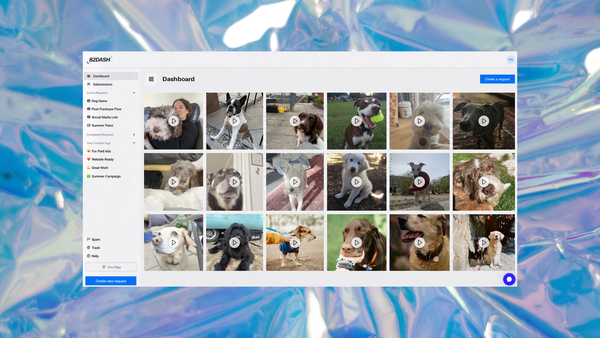
82DASH is built to make that supply reliable rather than accidental. It is a customer content library: photos, videos, feedback and reviews collected directly from customers, with rights cleared at the point of submission.
The flow is straightforward. A customer scans a QR code or taps an NFC tag on a receipt, on packaging, at a counter or in a follow-up message. They submit a photo or a short clip. A reward arrives on their phone in an Apple Wallet or Google Wallet pass within seconds, so the exchange completes while they are still thinking about it. The rights agreement is captured at submission, which is the step that makes the content usable behind paid media rather than only on your own channels.
That distinction has a name worth using. CGC, customer-generated content, is submitted directly to you, structured, and rights-cleared. UGC in the older sense is publicly posted, uncontrolled, and rights-uncertain. Only one of the two is safe to put ad spend behind, and only one can be planned as a supply rather than hoped for as a stream. Our glossary sets out the terms in full.
The performance case stands on its own, separately from any of the compliance argument. Nosto, formerly Stackla, finds customers are 2.4 times more likely to engage with customer content than brand-made content. Bazaarvoice puts conversion uplift above 160% when shoppers interact with customer photos. Nielsen has repeatedly found around 92% of consumers trust earned media above all advertising formats.
Underneath all of it sits a simple reallocation: pay your customers, not creators. The budget currently going to commissioned creative could go to the people who already bought the product. They will supply a photograph for the price of a small reward, and their version carries more weight precisely because nobody paid them to have the opinion.
Once the content is collected, tracking what it does is its own job. Our guide to tracking campaign performance with TikTok, Facebook, GA4 and Google Ads covers attributing results back to individual pieces of creative, which is the part most brands skip and then cannot answer questions about later.
Install 82DASH on the Shopify App Store
A Working Process for Mixed Creative
Most brands will keep running some generated imagery, and should. Here is a process that survives three rulebooks.
Keep an inventory with a provenance column. Every piece of creative, tagged as photographed, retouched, or generated. This takes an afternoon once and answers every future question in seconds.
Audit your automated creative features first. If you run campaign types that generate variants, go and look at what they have produced. Under Meta's framework those variants are your responsibility. This is the single highest-value hour in this entire article.
Declare rather than wait to be detected. Where a platform offers a disclosure control and your creative is generated, use it. A label you applied reads as transparency. The same label applied by a detection system after you did not declare reads as something else, and the platforms increasingly treat the two differently.
Treat "significantly modified" as the working threshold. It is TikTok's language and the most conservative of the three, so a process built to it clears the others.
Keep records of how creative was made. Vendor confirmations, internal review notes, tool used. Several of these regimes turn on what you knew, and being able to demonstrate what you knew is the whole defence.
Build a customer content supply before you need it. Collection has a lead time measured in weeks. The brands who will find Q4 comfortable are the ones who started asking in September.
Isabelle Simon, Communications Lead, 82DASH
Frequently Asked Questions
Do I have to label AI-generated ads on every platform?
There is no single answer, which is the central problem. Meta labels automatically for its own tools and for detected third-party generation. TikTok requires disclosure for AI content depicting realistic people or scenes across organic and paid. Google surfaces disclosure in a My Ad Center panel, automatically for its own tools and via an advertiser control otherwise, with on-ad labels where local law requires them. Build your process to the strictest of the three and you will clear the others.
Does retouching a real photograph count as AI-generated content?
Not under any of the three platform regimes as written. Colour correction, background removal and object cleanup are treated as editing rather than generation. TikTok's threshold of "significantly modified by AI" is the most conservative benchmark available, and ordinary retouching sits below it. The line everywhere is whether a person or scene has been invented.
What happens if I do not disclose and the platform detects it anyway?
It varies. Meta can stop the ad, apply a policy strike, and where it assesses the content as deceptive, reduce distribution substantially. TikTok can reject or restrict the ad under a tiered penalty system. Google applies its existing misrepresentation policy to deceptive creative. In all three cases the outcome is worse than voluntary disclosure would have been.
Am I responsible for AI variants a platform generated from my creative?
Under Meta's April 2026 framework, yes. The running advertiser is responsible for AI-generated variants regardless of who configured the campaign. If you use automated creative features, audit what they have produced under your account.
Does customer content need any of this?
No. A photograph or video taken by a real customer of a real product is not AI-generated content, carries no provenance metadata, and triggers no disclosure requirement on any platform. If the content is collected with rights cleared at submission, it is also usable behind paid media, which is the other half of the problem solved at the same time.
Further Reading
- EU AI Act: AI Marketing Images Now Need Labels. Customer Photos Do Not.
- AI-Generated UGC vs Real Customer Content: The ROI Comparison
- How to Balance Organic UGC and Paid UGC
- Pay Your Customers, Not Creators: The Alternative to Influencer Marketing
- Expanding AI transparency in ads, Google Ads & Commerce Blog