
How to Collect Customer Feedback Without Annoying Anyone
70% of people abandon surveys before finishing them. Here's how to collect honest customer feedback without the fatigue, the low response rates, or the awkward asks.
You've been on the receiving end of this.
You finish a meal, check out of a hotel, buy something online. Within hours there's an email asking you to complete a survey. Five minutes later, another one. The next day, a reminder. By the end of the week you've deleted all three without opening them.
That's the feedback problem most businesses have created for themselves. Not because they care too little about what customers think - but because the way they're asking is actively pushing people away.
There's a better approach. And it starts with understanding why people don't respond in the first place.
Why most feedback requests get ignored
Survey fatigue is real and getting worse. 70% of people have abandoned a survey before finishing it. The average email survey response rate sits at just 6-8% - meaning for every 100 customers you email, roughly 93 don't engage at all.
The reasons aren't complicated. The survey is too long. It arrives at the wrong time. There's no obvious reason for the customer to bother. And somewhere along the way, the business trained them that nothing visibly changes as a result of their feedback anyway.
That last point matters more than most businesses realise. Only 48% of businesses close the loop with dissatisfied customers - meaning more than half of the time, feedback disappears into a system and the customer never hears anything back. Why would they bother next time?
The timing problem
Most feedback requests arrive too late.
Feedback collected within 2 hours of an experience is 40% more accurate than feedback collected 24 hours later. The emotion is still there. The specifics are still fresh. Two days later, the customer has moved on - and even if they respond, what they give you is a vague impression rather than useful signal.
The businesses getting the best feedback aren't sending emails the next morning. They're capturing it at the moment the experience is complete - at the table, at checkout, immediately after the service ends.
In-person feedback collection at the right moment can reach 85-95% completion rates. Compare that to 6-8% for email. The channel and timing matter far more than the questions themselves.
The length problem
A survey that takes longer than five minutes to complete sees three times more dropouts than one that takes under five minutes.
Most businesses design feedback forms for their own benefit - covering every possible question, every possible metric, every department that wants to know something. The result is a 15-question form that a customer might complete once and never again.
The most useful feedback forms are short. One or two questions. A single NPS score and a text box. Done in 60 seconds or less.
Here's the truth: a 90% response rate on one honest question is worth more than a 4% response rate on a comprehensive survey. You learn more from real signal at volume than from detailed responses from the tiny minority who bothered to finish.
The incentive problem
Here's what most businesses miss: feedback is a transaction.
You're asking a customer to spend their time and attention giving you something valuable. The default expectation is that they'll do this out of goodwill alone. Some will. Most won't - especially the second and third time you ask.
The businesses getting consistent, high-quality feedback are treating it like any other exchange. The customer gives feedback. Something comes back to them - a loyalty stamp, a small discount, an entry to a monthly draw, a free add-on on their next visit.
This isn't buying positive responses. It's rewarding participation. The incentive is attached to the act of submitting, not the content of what's submitted. A customer who gives you critical feedback and gets a reward is far more valuable than one who gives you five stars because they felt obligated.
Customers who submit feedback are 14% more likely to stay with a brand than those who don't. The feedback act itself builds loyalty - independent of what the feedback says.
The channel problem
SMS surveys get response rates of 45-60%. Email gets 6-8%. That gap isn't going to close.
But the real opportunity isn't SMS either - it's the channel your customers already have open. The phone in their hand. The wallet they use every day.
A customer who has saved your loyalty pass to their Apple or Google Wallet is reachable via push notification - not email, not SMS, but a direct message to their lock screen. The feedback request arrives in a context they associate with your brand, at a moment you can control, with the reward already sitting in the same place they'll receive it.
That's a fundamentally different relationship than a cold survey email arriving 48 hours after their visit.
What good feedback collection actually looks like
The pattern that works is simple.
Ask one or two questions. Ask them at the right moment - immediately after the experience, not days later. Make the submission frictionless - a single screen, no login, no lengthy form. Reward the act of responding. And close the loop - let them know their feedback made a difference.
That last step is underrated. Telling customers "you said X, we did Y" lifts future response rates by 4-6%. Customers who see that their feedback is acted on become the most consistent contributors you have.
The businesses learning the most from their customers aren't running quarterly satisfaction surveys. They're collecting small amounts of honest signal consistently, at the right moment, with something in it for the person giving it.
Where 82DASH fits in
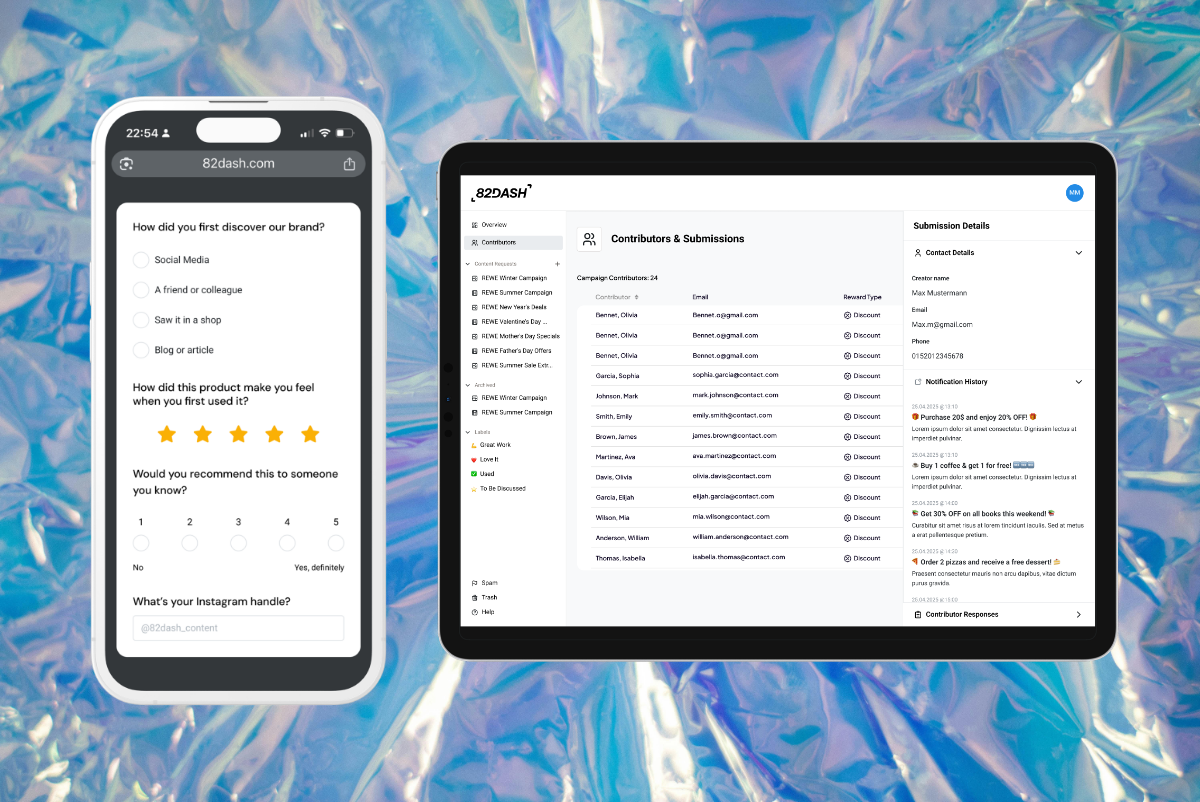
82DASH lets you build feedback collection directly into the same flow as content collection and loyalty rewards. A customer scans a code or taps a card, answers one or two questions, submits a photo or review if they want to, and receives an instant reward in their Apple or Google Wallet. The feedback arrives while the experience is still fresh. The reward closes the loop immediately.
No email sequence. No survey fatigue. No 6% response rates.
Just honest signal from real customers, collected at the moment it's most accurate.
Your customers have opinions about you. The question is whether you've made it worth their while to share them.
Isabelle Simon - Communications Lead - 82DASH
Further Reading
- The Post-Visit Engagement Problem: How Hospitality Businesses Lose Customers After Checkout - 82DASH Blog
- How to Use Wallet Passes to Collect Customer Content After Every Visit - 82DASH Blog
- Why Video Testimonials Beat Written Reviews - 82DASH Blog
- Survey Response Rate Benchmarks 2025 - SurveySparrow
- Survey Fatigue Statistics - Customer Thermometer
- Average Survey Response Rate 2025 - Clootrack
- Customer Satisfaction & Retention Statistics - Qualaroo
Further Watching
- r/CustomerSuccess - Reddit Community - real conversations about what feedback programmes actually work
- r/smallbusiness - Reddit Community - business owners sharing what drives honest customer responses
- Customer Feedback Strategy YouTube Search - practical guides on building feedback systems that get responses